
Students become co-researchers during their studies
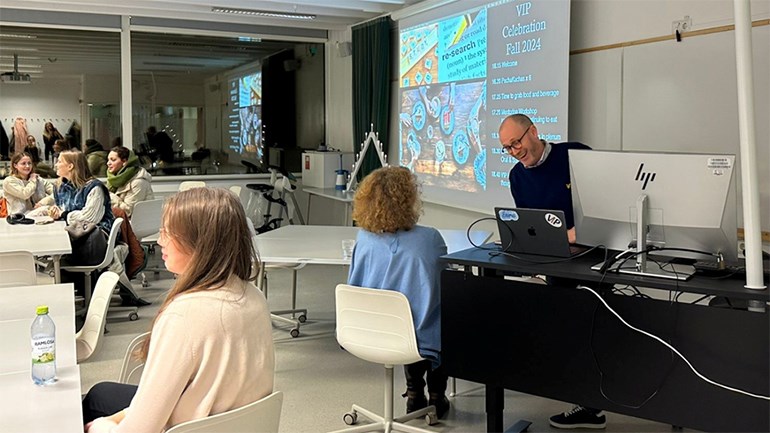
Petri Gudmundsson (right) engaged in conversation with a student during a VIP presentation. Photo: Marie Väfors Fritz
What if students didn't just learn about research, but took part in it too? This is the fundamental concept behind VIP (Vertically Integrated Projects), a new initiative at the university in which students collaborate with researchers on live projects.
Research as part of the course
VIP is based on a simple yet powerful idea: students learn best by participating in real research and innovation projects. For at least one semester, students join a project and contribute around 2–4 hours per week. In parallel, they attend four university-wide sessions focusing on themes such as the research process, innovation, leadership, and research communication.
Admission is not determined by grades.
“The most important thing is motivation,” says Petri Gudmundsson. “We want to find students who genuinely want to contribute to the project. In some cases there are language requirements, but above all it is about commitment. They should also have completed at least one year of higher education.”
A growing movement
The initiative is the first of its kind in Sweden and has grown rapidly. This semester, more than 100 students are participating in over 30 research projects.
And the results are beginning to show. Several former VIP students choose to continue their studies, and some have progressed to doctoral education; within criminology alone, this concerns at least four individuals.
“Those who stay in VIP for several semesters really grow in their roles,” says Marie Väfors Fritz. “Many later take on the role of mentors for new students.”
More than a course
VIP is not a traditional course. Instead, participation can be recognised through a Diploma Supplement known as CReMe (Credits for Research Merits), where the student’s contributions are documented in Ladok. The initiative was developed in dialogue with the students themselves.
“When we started, we asked students what they wanted to gain from this. It became clear that they wanted something concrete that demonstrates their merits and helps them stand out,” says Petri Gudmundsson. “This is exactly what is realised through CReMe.”
There are also opportunities for scholarships. Through donations, the programme has been able to offer grants of SEK 15,000, for example to attend conferences or to deepen engagement in projects.
The initiative is led by, among others, Petri Gudmundsson, Senior Lecturer at the Department of Biomedical Science, and Marie Väfors Fritz, Senior Lecturer and Head of Department at the Department of Criminology, together with Carl Magnus Olsson, Associate Professor at the Department of Computer Science and Media Technology.